 Meziantou.Framework
Railroad diagrams
editA RailroadDiagram draws the rules of a grammar as railroad diagrams, also called syntax diagrams: each rule is a track from a start marker to an end marker, through terminals and nonterminals, with branches for the choices and loops for the repetitions (Mermaid railroad-beta, railroad-ebnf-beta, railroad-abnf-beta and railroad-peg-beta):
var diagram = new RailroadDiagram { Title = "Numbers" };
diagram.AddRule("number", RailroadExpression.Sequence(
    RailroadExpression.Optional(RailroadExpression.Choice(RailroadExpression.Terminal("+"), RailroadExpression.Terminal("-"))),
    RailroadExpression.OneOrMore(RailroadExpression.Nonterminal("digit")),
    RailroadExpression.Optional(RailroadExpression.Sequence(RailroadExpression.Terminal("."), RailroadExpression.ZeroOrMore(RailroadExpression.Nonterminal("digit"))))));
diagram.AddRule("digit", RailroadExpression.Special("a digit from 0 to 9"));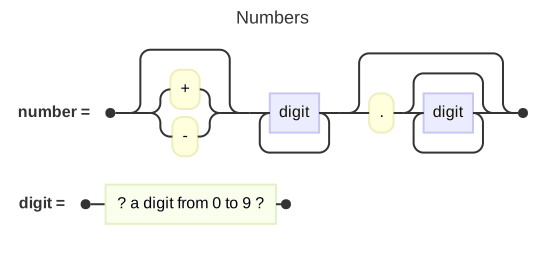
Expressions
A RailroadRule has a name and the RailroadExpression it stands for, which the static methods of RailroadExpression create:
| Expression | Drawing |
|---|---|
| Terminal | A literal text in a rounded box |
| Nonterminal | A reference to a rule in a box |
| Sequence | Expressions one after the other |
| Choice | Alternatives one below the other, between two branches |
| Optional | A bypass above the expression |
| Repetition | A loop below the expression, and a bypass when it can be skipped |
| Special | A description, ? text ?, in a box |
A repetition has a Minimum and a Maximum; other bounds than zero or one to unbounded, such as the 2*4 of ABNF, are written below the loop.
Mermaid syntax
var diagram = (RailroadDiagram)MermaidDocument.Parse("""
    railroad-ebnf-beta
    title "Numbers"
    number = [ "+" | "-" ] digit+ ( "." digit* )? ;
    digit = ? a digit from 0 to 9 ? ;
    """).Content;
The keyword sets the Notation, which the writer uses too. Every rule ends with a semicolon.
| Notation | Keyword | Rule | Choice | Optional | Repetition | Comments |
|---|---|---|---|---|---|---|
| Constructors | railroad-beta | name = expression ; | choice(a, b) | optional(a) | zeroOrMore(a), oneOrMore(a) | /* */ |
| EBNF | railroad-ebnf-beta | name = ... ; or ::= | a \| b | a?, [ a ] | a*, { a }, a+ | /* */, (* *) |
| ABNF | railroad-abnf-beta | name = ... ; | a / b | [ a ], *1a | *a, 1*a, 2*4a, 3a | ; text |
| PEG | railroad-peg-beta | Name <- ... ; | a / b | a? | a*, a+ | # text |
As in Mermaid, an EBNF exception a - b is drawn as a sequence with a - terminal, the predicates &a and !a of PEG and its . are special sequences, the numeric values of ABNF (%x30-39) are terminals, and an identifier cannot start with title. In ABNF, a semicolon ends a rule only at the end of its line: followed by text, it starts a comment. The writer throws an ArgumentException for an expression the notation cannot write, such as bounded repetitions out of ABNF, or special sequences in ABNF.