 Meziantou.Framework
Class diagrams
editA ClassDiagram draws classes linked by relations (Mermaid classDiagram):
var diagram = new ClassDiagram();
var animal = diagram.AddClass("Animal");
animal.Annotations.Add("abstract");
animal.AddMember("int age", ClassMemberVisibility.Public);
animal.AddMember("makeSound() void", ClassMemberVisibility.Public).IsAbstract = true;

var duck = diagram.AddClass("Duck");
duck.AddMember("String beakColor", ClassMemberVisibility.Private);
duck.AddMember("swim()", ClassMemberVisibility.Public);

var pond = diagram.AddClass("Pond");
pond.AddMember("count() int", ClassMemberVisibility.Public).IsStatic = true;

// Duck inherits from Animal; a Pond is made of Ducks
diagram.AddRelation(animal, duck, fromEnd: ClassRelationEnd.Inheritance);
var relation = diagram.AddRelation(pond, duck, fromEnd: ClassRelationEnd.Aggregation, label: "hosts");
relation.FromCardinality = "1";
relation.ToCardinality = "*";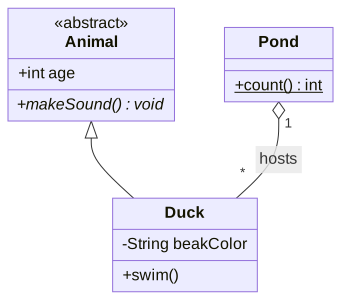
Classes
A ClassDiagramClass is a box of three compartments: its Annotations («interface») and its name, its attributes, and its methods. A ClassMember whose text has parentheses is a method; its Visibility is shown with the characters of UML (+, -, #, ~), a static member is underlined and an abstract one is in italic. The generic types are written List~int~, as in Mermaid, and shown List<int>; GenericType is the generic parameter of the class. HideEmptyMembersBox hides the empty compartments.
Relations
A ClassRelation has a decoration at each end: an Inheritance triangle, a Composition or an Aggregation diamond, an Arrow; a dashed line (IsDashed) makes a dependency or a realization. The multiplicities are drawn next to the ends, and the label in the middle.
| Mermaid | Relation |
|---|---|
A <\|-- B | B inherits from A |
A *-- B | A is composed of B |
A o-- B | A aggregates B |
A --> B | A is associated with B |
A ..> B | A depends on B |
A ..\|> B | A realizes B |
A -- B, A .. B | A link |
Namespaces, interfaces and notes
A ClassDiagramNamespace groups classes in a frame, and can nest. A ClassDiagramInterface is drawn as a lollipop: a small circle linked to the classes that provide it (Mermaid bar ()-- Foo). A ClassDiagramNote is alone or attached to a class:
var diagram = new ClassDiagram { Direction = DiagramDirection.LeftToRight };
var orders = diagram.AddNamespace("Orders");
var order = new ClassDiagramClass("Order") { GenericType = "TItem" };
order.AddMember("List~TItem~ items");
orders.Classes.Add(order);

var serializable = new ClassDiagramInterface("ISerializable");
diagram.Interfaces.Add(serializable);
diagram.AddRelation(order, serializable, toEnd: ClassRelationEnd.Lollipop);
diagram.AddNote("Orders are immutable once paid", order);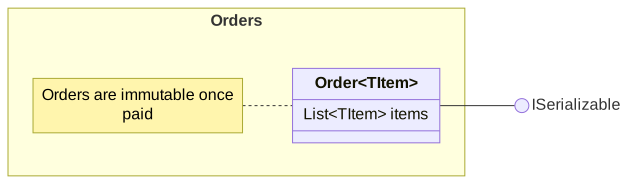
In Mermaid, the dotted names of the namespaces nest them (Company.Engineering is in Company), unless the configuration sets class.hierarchicalNamespaces to false.
Mermaid syntax
The parser reads the classes (class Name, class Name~T~["label"], class `Name with spaces` , with their members between braces or as Name : +member), the annotations (<<interface>> Name), the relations with their multiplicities and labels (A "1" --> "*" B : label), the lollipops, the namespaces, the notes (note "text", note for Name "text"), direction, classDef, cssClass, :::class, style, and the links of click and link.